WELCOME!

Welcome to Le Beau Paon Victorien! I'm so glad you stopped by!

Here you will find a variety of things that might interest you: food, books, house decor, crafty things, random thoughts, dishes, gardening and more!

Spend some time with us and happy reading!


Showing posts with label Misc. Show all posts

Saturday, September 22, 2012

Farm Life

Both of my parents grew up on a farm; my Dad's family had a turkey farm and later a dairy farm. Many of his relatives, who were from Michigan, were loggers and those who were not loggers, were farmers. My Dad's father was Belgian; his family, before emigrating to America, were sheep farmers.

My mother moved to a farm with her family when she was about twelve or thirteen years old. Her grandparents had both come from farming families, potato farmers to be exact, after arriving from Poland they settled in Chicago, but were soon lured to northern Wisconsin, where farm land was being given away for free. Later, after my great-grandparents were grown and had married, they decided to move to Milwaukee to try life away from farming. My great-grandfather got a job driving a streetcar, which was lucky for his family, because he didn't lose his job during the Great Depression like so many others did.
Many years later, his second oldest son, my Grandpa, decided that he wanted to buy a farm, so he did, taking his wife and seven children with him. My Mom was about twelve or thirteen at the time, the second oldest of seven children. My Grandpa still had a regular day job; the farming part was mostly like a "hobby farm", although he did plant fields and they had animals; goats, rabbits, chickens, a few cows and horses. They also had a very large vegetable garden and an orchard. Growing much of their own food was helpful when you had a large family of growing children and not much money.

By the time I was born, my Dad's parents still lived on their farm, but they no longer kept a dairy herd and my Mom's parents, though still living on their farm also, kept no animals anymore and the fields were rented out. As the years went by, my grandparents aged and by the time I was in high school, their farms had been sold, the equipment auctioned off and long gone; my parents had careers ( my mom a nurse, my dad had his own business), so I never knew what it was like to live on a working farm myself.
But, the farm life loomed hugely in my memory, from stories and pictures from the past, and me and my siblings and cousins had always enjoyed visiting our grandparents so we could play in the huge empty barns, swing on old pasture gates, hide under the corn crib, and dive into the hay in the loft (which we were forbidden to do, but did it anyway!)


A few years ago, one of my cousins, and her husband, decided that they wanted to buy an old c. 1850s farmhouse, which also came with a few acres of land, and numerous barns and outbuildings. They also decided to become goat farmers. Every year they have a Labor Day picnic at their goat farm, and me and my extended family, all of us "city folk" go out to the picnic and have a fun day "on the farm".

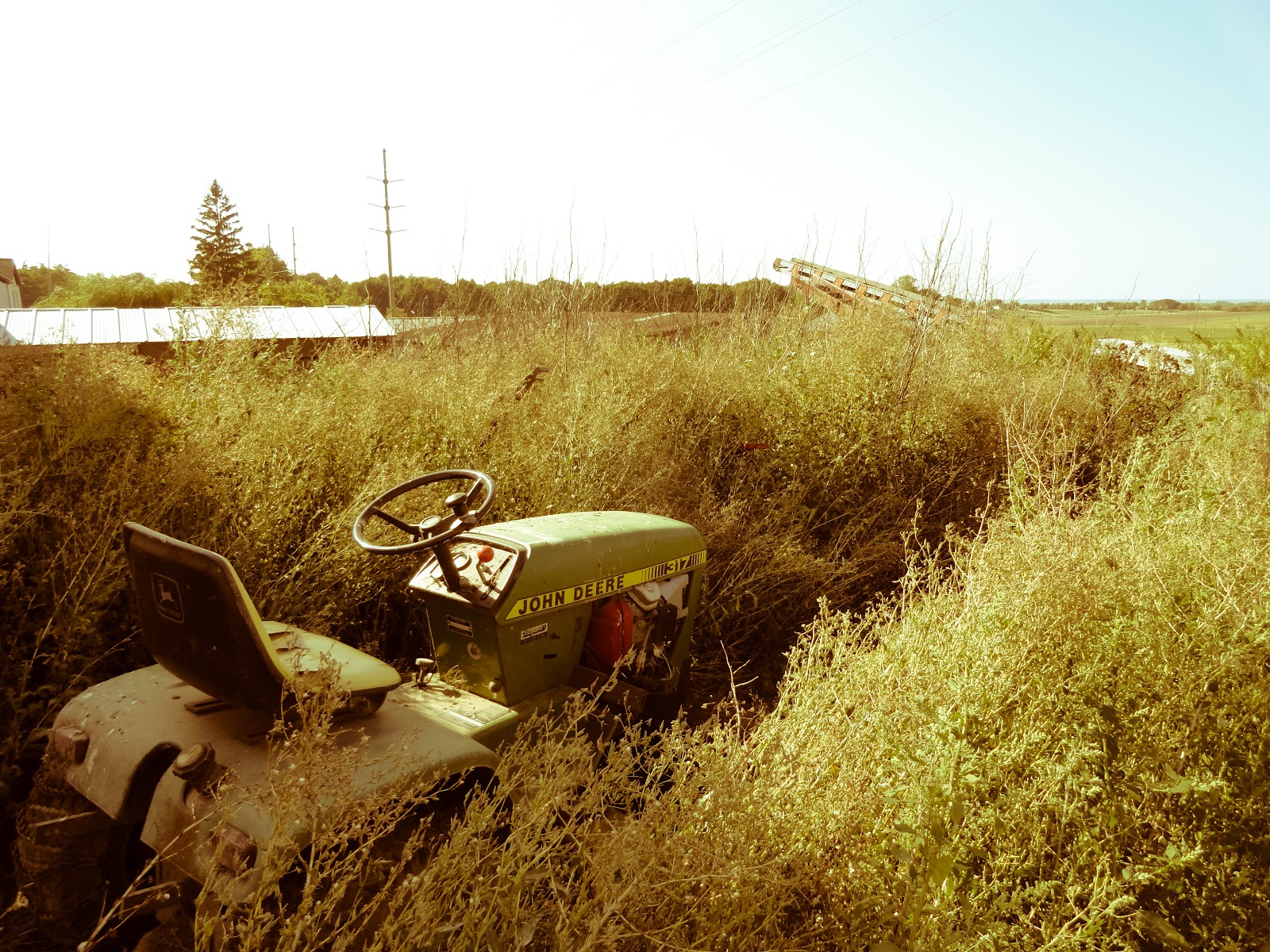
These are all pictures that I took this last Labor Day at the farm, and then edited using my new editing program.




The old smokehouse


They do have some cows; a few young Holsteins and two Herefords.


These are actually some of the young kids. There are two pens of the kids, who were all born this last spring. One pen holds all the males, the other are females.

I have forgotten now exactly the number of kids that were born this spring a the farm... but I think it was close to sixty or seventy kids!


These are the adult females. There is only one adult male; the "billy", who 'services' all the females, but he is kept with the cows in the cow pasture.
Evidently you can "rent" other males if you want to have some genetic diversity in your goat herd. 

The two Herefords are actually a mom and her baby. The heifer is called "Big Mama". The baby doesn't have a name yet, although she is a couple months old already.


I got this picture of my Mom when I was looking down the hay chute. She's holding onto my Grandpa's arm as they were walking around in the lower level where the goats are. At nearly 95, my Grandpa still loves to talk about his own farming days and it's a great treat for him to come see my cousin's farm.

Just like cows, the adult female goats get milked twice a day. There are about 50 adult female goats. They can fit two rows of ten goats in the milking room at a time, where they get hooked up to the automatic milking machines. If you walk into the milking room, they all will turn and look at you. Goats are very curious creatures; they are also very friendly and entertaining to watch and have quite distinct personalities.


Black and white version:


Thanks for stopping by! I hope you enjoyed a taste of the "farm life"!
Photobucket

Saturday, June 2, 2012

Going Back to the 19th Century at Old World Wisconsin


Just recently, for Mother's Day, actually, I attended a Mother's Day brunch with my mother and sisters at a very special place.

It's an "outdoor history museum" called Old World Wisconsin (click HERE to learn more.Click on
 the "Explore Old World Wisconsin" and then click on the Interactive Map for more pictures and info about the buildings), which depicts the life of 19th-century rural pioneers and immigrants, and includes 65 historical buildings, most of which are  from areas in Wisconsin that were painstakingly dismantled, moved to the site and carefully rebuilt.

The historic structures include ethnic farmsteads, rural outbuildings, furnished homes and an 1870s crossroads village, complete with traditional, small-town necessities ( a church, blacksmith shop, carriage-maker shop, general store, boarding house/inn, cobbler's shop, town hall and one-room schoolhouse), all set in a beautiful prairie and woodland setting that looks very much like south-eastern Wisconsin would have looked to the early pioneers.


Costumed volunteers and artisans work and farm in the outdoor museum and there are many popular events, including Barn Dances, Vintage Base Ball weekend ( a base ball game played by the rules of 1860), Day Camp for children, interactive work shops and much more. It is also a very popular place for  school Field Trips.


I visited Old World Wisconsin as a fourth-grader for a school field trip, back in 1979, which was three years after it opened in 1976, but that was the last time I had been there. Now, 33 years later, I made my second visit for a Mother's Day Brunch that was being held in the Clausing Barn. (below)

There used to be many large trees that shaded the area around the barn, but about three years ago a tornado came through the area and all of the big trees went down. Miraculously, none of the historic buildings were damaged, although many people's homes were destroyed nearby.

They had the inside beautifully set up with tables and a very delicious brunch buffet. Afterwards, we all bought tickets to tour the "museum".


One of the first areas to visit is the 1870s "Crossroads Village", and the Thomas general store, pictured below.

The Four Mile Inn is also in the village; a boardinghouse and inn.

In St. Peter's Church, some of the church ladies were having a "sale" of hand-crafted items to benefit the poor. One was kind enough to play a few hymns on the pump organ for us.


I had a special interest in taking pictures of the kitchens and pantries of the historic homes. This was the pantry in a house called Hafford House, which was a very small house. I am always trying to envision what kitchens looked like in the 19th century. I often have people ask what the kitchen in our house probably looked like when it was built in 1886. The houses in "Crossroads Village" are rural and from the 1870s period, but the way kitchens looked by the 1880s wasn't probably hugely different. People don't often understand that kitchens of the past were nothing like we know them today.

I also love to see the dishes and cookware! Everything in the village is authentic, or if it was rebuilt (like a woodworking bench that is used for workshops in another building or the fences) it has been built with materials and in the way that it would have been made in that time period....meaning, made by hand with hand tools of the time period.

This is the kitchen in another house that was called the Benson House. The building names are the actual names of the owners who originally built them and they all have a known history to go along with them. 
This type of stove shown was the most common in use during most of the 19th century. They were mostly wood-burning stoves. Every spring they would be "blacked", using "stove blacking", which was a type of polish. Blacking the stove prevented corrosion and rust of the metal. 
The Benson family was a little more well-off than the Haffords. Their house is a little larger and they have nicer things. They also have a parlour, which the Haffords did not (The Haffords used their kitchen as both a kitchen and sitting room/family room).

The Benson House sitting room has wallpapered walls, a desk, comfortable chairs, it's own stove for heat, a table by the window that was handy for serving refreshments for guests ( there is a lovely water tippler on the table) and decorative ingrain carpeting. Ingrain carpeting was the most popular carpeting in 19th century rooms until about the  1880s-1890s. To learn more about the types of carpeting and other decorative elements popular in the 19th century, click HERE to read a post I wrote about Victorian period decorating.

In an adjoining room you can glimpse a small parlor organ (also known as a pump organ or harmonium)
The stove in the center of the room was probably a coal burning stove. Our house once had them in every room that didn't have a fireplace, as evidenced by the flue holes that are still present, albeit covered over.


This is the Sanford House. The Sanford House is actually about c.1860s. The Sanfords were farmers but were quite successful and well-to-do and they had a large family that included six children, I believe.

Mr. Sanford's study and desk were quite impressive. Erik was quite taken with this desk and would love to have one like this in his Victorian gentleman's study!


This elegant piano was placed in a front room of the Sanford house.


Across from Sanford House is a historic barn, Loomer Barn, and many beautifully fenced fields. A rural village in 1870 would have looked very much like this, with great spaces of fields between the few houses and buildings that made up a tiny little village.  There are farm animals at Old World Wisconsin; mostly oxen and horses of the breeds that farmers of the 19th century depended on for farm work.  Just like everything else here, all the farming is done using authentic historic farm equipment and implements and traditional farming methods. You can even take a workshop to try your hand at it yourself if you want to experience, first-hand, how to perform domestic chores, such as clothes-washing, plowing, preparing meals and working in the fields!

I have more to show but I am going to break it up into two posts so that this doesn't get overly long!


Thanks for stopping by! Part 2 will be coming soon!

Photobucket